You set the goal in January. By March it is quietly gone, and somewhere underneath the busy days there's a small voice asking what's wrong with you. Nothing is wrong with you. You don't have a motivation problem. You have a system problem.
Most goal-setting systems tell you to want it more. Visualize harder. Repeat affirmations in the mirror until you believe them. I spent years on that road, and I'll tell you what I found at the end of it: belief is not enough. You can believe with your whole heart and still not move, because believing is not the same as having a process that carries you forward on the days you don't feel like it.
A goal achievement system is that process. It's the machinery that moves a goal forward whether you wake up inspired or exhausted — and unlike most goal-setting advice, it doesn't just tell you to plan forward and hope. It works backward from the goal already achieved, so you know the exact steps between here and there instead of guessing at a to-do list. This page lays out the whole thing, all eight phases — the same system I've used to buy apartments I once couldn't afford. Take it one phase at a time.
What Is a Goal Achievement System?
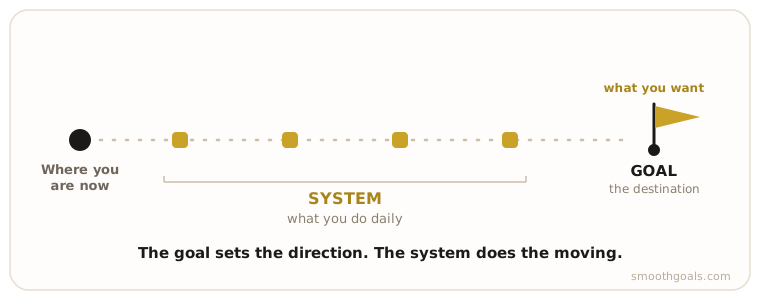
A goal is what you want. A system is the repeatable process you run to get it. They are not the same thing, and confusing them is why most goals die.
Think of it the way the difference shows up everywhere. Your goal is to run a marathon; your system is your training schedule. Your goal is to grow the business; your system is what you actually do, day after day, to make it happen. The goal sets the direction. The system does the moving. A New Year's resolution has a direction and nothing underneath it — which is exactly why it fails. If you want the longer version of this distinction, I wrote a whole piece on goals vs. systems.
So a goal achievement system has one job: to close the gap between where you are now and where you want to be — reliably, not occasionally. Everything below is how Smooth Goals does that.
Why Desire Isn't the Problem
Most advice assumes that if you wanted it badly enough, you'd already have it. That's backwards. Desire is rarely what's missing. Here's the mechanism almost nobody talks about.
You burn your energy on inner conflict, not action
In an ordinary day you play many roles — worker, partner, parent, friend — and they don't all want the same thing. The worker wants to earn more; the parent wants to be home by six. When those pull against each other, you spend your energy refereeing the fight instead of doing the work. There's a simple formula for it:
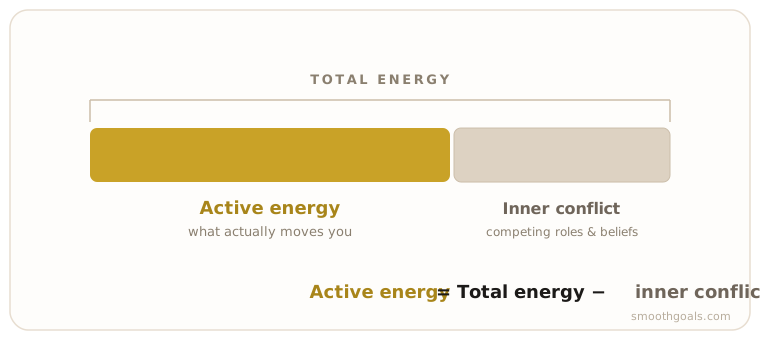
The more conflict, the less you have left to actually move. The fix is to get your roles pulling in one direction and focus on one goal at a time — which is also why people who chase five goals at once finish none of them. More on that in why you can't stick to your goals and how to handle having too many goals.
The Smooth Goals System, Phase by Phase
Two quick pieces of groundwork before the goal itself. First, check your values. Ask yourself honestly what you actually want your life to add up to — not what you're supposed to want, what you want. There's no point climbing a ladder fast if it's leaning on the wrong wall. Get that wrong and the goal itself doesn't matter.
Second, get two notebooks, and keep them separate. One is for the exercises in this system — Wheel of Life, Ideal Scene, Back From The Future, all the things you'll do once and refer back to. The other is your daily action journal — what you plan each morning and review each evening, Phase 7's engine room. Mixing the two turns your daily journal into a mess you have to dig through to find yesterday's plan. I'm old-school and write both by hand; do what suits you.
Now the system. Eight phases.
Phase 1 — Aim: pick one goal without unbalancing your life
Start with the Wheel of Life. List six to eight areas that matter — health, money, career, relationships, skills, social life, contribution — and honestly rate where each one sits today. You get a bird's-eye view, and two things jump out: which area needs attention, and where you're about to over-invest at the cost of everything else. Target money and neglect your health and the system will stall when your health does.
Then choose one goal. One. This is the hardest discipline for ambitious people and the most important. Each goal you finish makes you stronger for the next one. I go deeper on choosing in why chasing several goals finishes none of them.
Phase 2 — Define: turn the goal into a real target
Make the goal specific, measurable, attractive, realistic, and time-bound — then go past the standard checklist with two moves most systems skip.
First, aim at the qualities, not the label. Don't set the goal as "get the job at Company X" or "marry that particular person." You're fencing yourself in. The specific company or person may be perfect, but you don't know that yet, and you may miss something better. Be specific about what you actually want — the kind of work, the atmosphere, the salary, the qualities — and stay open to which person or company actually delivers it.
Second, find the goal behind the goal. Money is almost never the real target; it's a stand-in for freedom, security, or something you want to do. Goals pinned to a number often fail because the number was never the point. Name what the goal is really for.
Then score its difficulty from 0 to 10, where 0 is effortless and 10 is impossible with what you have today. Start with something in the 4–6 range. Win a few of those and the harder goals stop looking impossible. The full method for setting a goal you'll actually finish is in goals you'll actually achieve, and the why-it-works behind scoring is in process goals vs. outcome goals.
Phase 3 — Clear the blocks
Here's a test. Picture yourself achieving the goal, starting tomorrow. Are you a hundred percent sure you'll get there? If you hesitated, something inside disagrees with the goal — and that something will quietly sabotage you no matter how good your plan is.
When I was young I was unbeaten at arm wrestling. I beat men twice my size, because I simply didn't know defeat — until one day I lost to a powerhouse from another town. After that I started losing to people I'd always beaten. Nothing in my arm had changed. My history had changed, and it was steering the present. Past experience runs the show far more than we admit, and the connections aren't even logical: a failure with a girl can show up years later as a failure to close a sale.
Smooth Goals has two tools to release that grip — the History Change Method, which reworks how you hold a past experience so it stops bleeding into the present, and the Fingers Method, a two-minute exercise you can do any time you feel the resistance rise. Both come from the useful parts of NLP, stripped of the ritual. I made a short video walking through each one. The full step-by-step drills, and how to use them on a real goal, are in Goal Mastery and the course — that's where this gets hands-on. The deeper background on why old experiences run the present is in the limiting beliefs that hold you back.
You repeat this phase until that test gets a clean yes.
The History Change Method
The Fingers Method
Phase 4 — Picture the win: the Ideal Scene
This is where I part ways with the visualization crowd. Sitting on a cushion picturing a Ferrari does nothing on its own. But a structured Ideal Scene does real work, for two reasons: it makes the goal vivid enough that all of you actually wants it, and it tells you how you'll know the goal is done.
The Ideal Scene is the goal written as a lived experience — a specific place, a specific time, the people there, what's happening — described the way you'd hand a scene to a film director. "I run my own business, five thousand a month net, relaxed, lots of travel and people, doing work I love." Refine it until it scores a perfect ten. The difference between this and does visualization actually work is structure, and it matters.
Phase 5 — Map it backward: Back From The Future
This is the phase I told you about at the top — the most distinctive move in the whole system. Most people plan forward from today, guessing at what the next step should be. We do the opposite: start from the goal already achieved, and work backward.
Stand inside the Ideal Scene — the goal already achieved — and ask: what happened the day before this? Then the scene before that. Don't strain. Let your imagination walk you backward, scene by scene, all the way to today. Each stop is an intermediate outcome, written as a short dated scene you can rearrange later. You're not guessing at a plan; you're remembering a future you've already decided on. You become the scriptwriter of your own life.
Building a house, you'd work back from moving in: inspection, construction, contractor, permit, land, funds. A business is murkier, which is exactly why the backward walk earns its keep — it surfaces the milestones forward-planning misses. The full method is in how to break down a big goal. It's the piece I'd hand a friend first.
Want a guided start instead of doing all eight phases solo? Start the free course — the Momentum Method walks you through the first phases, one short email at a time.
Phase 6 — Plan the atomic actions
Take the scene closest to today and ask what you'd have to do to make it real. Write those actions in your journal — but break them down until each one is so small it creates no resistance. Not "launch the business." Wake at 6:30. Rehearse the pitch three times. Call Mr. X for a meeting. Tasks small enough that you can almost do them without thinking are tasks you'll actually do. Then cascade: the year's goal into months, months into weeks, weeks into today's short list. Plan your day, or other people will plan it for you, and your goals are not their priority.
The system also has you set standing policies and procedures — a fixed rule you don't renegotiate daily (a minimum you hit no matter what), plus the written sequence of steps for tasks you'll repeat. When I started beekeeping I dreaded the complicated jobs, until I wrote down the exact steps and what to bring; after that they were easy. Building your own policies and procedures is hands-on work we do inside the course, because they have to fit your goal. The link between small actions and steady results is covered in process goals vs. outcome goals and the planning mechanics in implementation intentions.
Phase 7 — Execute daily: the Work Plan
This is the engine room. Each morning, read your Ideal Scene and run the certainty test; if the resistance is back, two minutes of the Fingers Method clears it. Check your actions, add anything new, and do the work. Each evening, walk back through the day in your journal — what did you do that moved the goal, and what's tomorrow's list?
You'll hit your first milestone and it won't look like you pictured. That's not failure; that's feedback from the environment telling you what to adjust. The bank says no, family says yes; the plan bends, the goal holds. The only way to truly fail is to quit, and people quit because they expect a straight line. A rocket spends most of its fuel in the first seconds, fighting gravity to get off the ground. Once it's up, everything gets easier. Your first steps are the same. How to keep the daily engine running is in how to stay consistent, and how to lower the resistance that stops you starting is in how to make goals easier.
Phase 8 — Track and steer
You wouldn't drive across the country without checking the signs. Pick the one or two numbers that show real progress — money per week, units sold, sales calls made, kilos lost — and plot them on a graph. Scale the graph tightly: if you sell five to ten a week, run the axis 0 to 12, not 0 to 100, or the line looks flat and tells you nothing. In one company I ran sales for, we put the graph somewhere everyone could see it, and sales moved — teams saw each other's numbers and started competing to be the one pulling ahead.
What you do next depends on the slope. Trending up calls for one set of moves; flat or falling calls for another. Smooth Goals has specific Success Formulas for each state — they're laid out in full in Goal Mastery and the course. The tracking groundwork is in how to track goal progress.
You've got the map. Goal Mastery hands you the full engine — every drill for the History Change and Fingers methods, your policies and procedures built out step by step, the Success Formulas for whatever stage you're in, rising, flat, or stalled. It's the difference between knowing the system and running it at full speed. Get the book
Start Here Today
Don't try to run all eight phases tonight. Take one notebook and one goal, draw your Wheel of Life, and write the goal down. That's the whole assignment. The first step is the hardest because of inertia — so make the first step small enough that you can't talk yourself out of it.
One more thing, for when you get there. The day you know you'll hit the goal, set the next one — bigger. I remember when buying a sixty-square-meter apartment took everything the system had; a couple of years ago I bought one twice the size without needing the system at all. Success becomes normal, and the only way to keep growing is to keep raising the game. That's what it means to become the master of the game rather than a passenger in it.
Start the Momentum Method — free
Start the Free CourseThe Momentum Method walks you through the first phases of the system, one short email at a time. Free.
When you want the full drills — the History Change and Fingers methods step by step, the Success Formulas, the policies and procedures built around your goal — they're in Goal Mastery. And if you'd rather build your system with someone who's done it, the first coaching call is free; you decide afterward.
Goal Achievement System FAQ
What are the 8 phases of the Smooth Goals system?
Here's how to achieve any goal using the Smooth Goals System: Aim, Define, Clear the blocks, Ideal Scene, Back From The Future, Plan the atomic actions, Execute daily, Track and steer. Each phase is covered in full above.
What makes this different from other goal-setting systems?
Most systems plan forward and hope, and treat resistance as a willpower problem. This one plans backward from the goal already achieved to surface the real intermediate steps, and clears the specific mental blocks that stall you instead of asking you to push through them.
What's the difference between a goal and a system?
A goal is the outcome you want; a system is the repeatable process you run to reach it. The goal points the direction. The system does the work, especially on the days you don't feel motivated.
Do I need motivation to achieve a goal?
No, and relying on it is the common mistake. Motivation is a feeling that comes and goes. A goal achievement system is built to keep you moving when the feeling is gone — through small daily actions, a clear plan, and a feedback loop.
How many goals should I work on at once?
One. Your energy is finite, and splitting it across several goals means none of them get enough to cross the line. Finish one, get stronger, move to the next.
How long does it take to achieve a goal with this system?
It depends on the goal's difficulty and your starting point. The system is built to shorten the path by removing the hidden blocks that stall people and by breaking the goal into small daily actions — and to keep you from quitting in the long middle stretch where most people give up.
Is this just positive thinking or visualization?
No. Positive thinking and visualization alone don't reliably produce results. This system uses a structured Ideal Scene to clarify the goal, then concrete tools and daily action to reach it. Belief is the starting point, not the method.