You started strong. The first week you were unstoppable — early mornings, the plan written out, real momentum. Then a day slipped. Then a week. Now the goal sits somewhere in the back of your mind, half-abandoned, and underneath it is the question that actually stings: what is wrong with me?
Nothing is wrong with you. I've watched capable, driven people ask that same question — often about the one goal that won't stick, while everything else in their life runs fine. That's the tell. If you were lazy or weak, it would show up everywhere, not just here. Where you succeed, you're running a system, even if you never called it that. Where you don't, you're doing something different — winging it, hoping, relying on how you feel that day. That's the actual gap, and it can be closed. Let me show you what's actually happening.
It's Not a Willpower Problem
The standard advice is some version of "just be more disciplined." It sounds right, and it's almost completely useless — not because discipline doesn't work, but because this version of it treats discipline as a fixed trait, a test of your character, instead of something you build. So every time you slip, you don't just lose a day — you collect more evidence that you're the kind of person who can't follow through. That belief then makes the next slip easier. You're not just failing at the goal; you're slowly proving a story about yourself, and the story does more damage than the missed days ever did. (Built right, discipline does beat motivation — but built, not willed.)
Willpower is real — psychologists define it as your capacity to override impulses and stick to a long-term goal over a short-term one. But it's a finite capacity, not a fixed trait, and it drains with use, especially under stress and fatigue. If your whole plan depends on having enough left over on an ordinary Tuesday when you're tired and something goes wrong, the plan will fail on exactly the day it's needed most. The people who stick with things aren't walking around with more willpower than you. They've quietly built systems that don't ask so much of it.
So if it isn't willpower, what is it? It's almost always one of four things, and none of them are about your character.
The Real Reasons Goals Don't Stick
Your goals are quietly fighting each other
This is the big one, and almost nobody names it. In a single day you play several roles — worker, partner, parent, friend, the person who wants to get fit. Each role wants something different. The worker wants to stay late and earn; the parent wants to be home by six; the person getting fit wants the gym at five. When those pull against each other, you spend your energy refereeing the conflict instead of acting on the goal.
There's a simple way to see it:
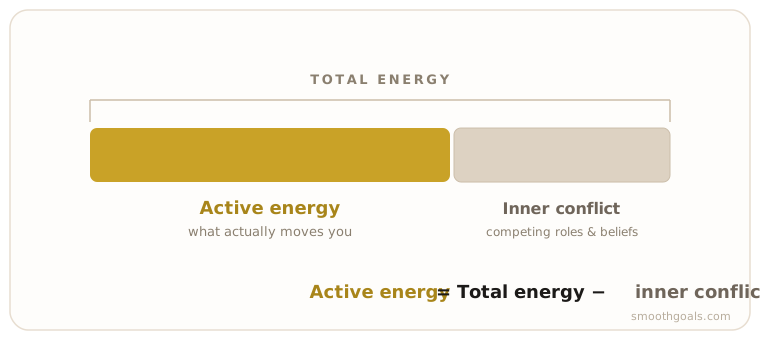
The more your goals and roles contradict each other, the less you have left to actually move. You're not low on willpower. You're spending it all on a tug-of-war you can't see. This is also why chasing several goals at once leaves you finishing none of them — your energy gets split until nothing has enough behind it to cross the line. (I go deeper on this in how to handle too many goals.)
You're running on motivation, and motivation always runs out
Most people treat motivation as the fuel. It isn't — it's the spark, and sparks go out. If you only do the work when you feel inspired, you'll do it rarely, because inspiration shows up on its own schedule and never the days you need it most.
The fix isn't to manufacture more motivation. It's to stop needing it — the same shift behind the goals vs. systems idea. You don't wait to feel like a disciplined person and then act; you act the way a disciplined person acts, on a small scale, and the feeling catches up later. That's a real, learnable skill, and it's the difference between people who finish and people who restart every January. More on the mechanics in discipline vs. motivation and why you lose motivation halfway through.
You quit in the messy middle
Every goal has a long, ugly stretch in the middle where you're putting in the work and nothing visible has changed. Progress is invisible right up until it's obvious. Most people read that silence as failure and walk away — often a single step before the results would have shown up.
I've done it myself. The hardest part of any goal isn't the start or the finish; it's the part where you have to keep going on faith, before the evidence arrives. Knowing that stretch is coming — and that it's normal, not a sign you've chosen wrong — is half the battle.
One missed day and you call the whole thing off
This one's almost funny when you see it from the outside. You miss a workout, or eat the thing, or skip a day of writing, and some part of you decides the whole project is now ruined — so you may as well stop. All-or-nothing thinking has ended more goals than laziness ever has.
A goal isn't a clean sheet you smudge once and throw away. Missing a day is just missing a day. Messy consistency — showing up imperfectly, often — beats rigid perfection every single time, because rigid perfection always breaks, and when it breaks people quit entirely.
What Actually Makes a Goal Stick
Look back at those four reasons. Notice what they have in common: not one of them is solved by trying harder. You can't out-discipline conflicting goals, or grit your way past invisible progress. Pushing harder on a broken setup just exhausts you faster.
What works is the opposite move. You stop relying on yourself to be strong every day and you build something that carries you when you're not — when you're tired, busy, and uninspired. Something that decides in advance what you'll do, removes the daily negotiation, and shows you you're making progress even when it doesn't feel like it.
That's the whole idea behind a goal achievement system: you don't need more willpower, you need machinery.
Start With One Thing Today
Pick one goal — just one — and write down the single smallest action that moves it forward. Not the plan. Not the whole staircase. The first step, small enough that you can't talk yourself out of it. Do that one thing today. That's how sticking actually starts: not with a surge of willpower, but with one small action you didn't need to feel inspired to take.
Start the Momentum Method — free
Start the Free CourseThe Momentum Method walks you through building a goal that holds — one short email at a time. Free.
FAQ
Why can't I stick to my goals?
Usually for one of four reasons, and none of them is weakness: your goals are competing with each other for the same energy, you're depending on motivation instead of a system, you're quitting in the long middle stretch before results show up, or one missed day makes you abandon the whole thing. All four are fixable once you can see them.
Is it normal to lose motivation halfway through a goal?
Completely normal. Motivation is a feeling, and feelings fade — especially in the middle, where you're working hard and nothing visible has changed yet. The answer isn't to chase the feeling back; it's to build a process that keeps you moving without it.
How do I stick to a goal when I don't feel like it?
Make the next step small enough that feeling like it doesn't matter. Decide in advance what you'll do and when, so there's no daily negotiation to lose. You act first; the motivation tends to show up once you've started, not before.