You've done everything right. The goal is clear, the plan is sound, you've built the discipline to follow it. And still — you don't move. You sit down to make the call, send the proposal, start the thing, and somehow you're doing anything but that. Then comes the familiar self-blame: I guess I'm just lazy.
You're not. When a capable person with a good plan keeps not acting, laziness is almost never the answer. Something underneath is fighting the goal, and it usually has a name: a limiting belief. It's the most overlooked reason goals stall, because it hides where you're least likely to look — inside your own certainty about what's true.
What a Limiting Belief Actually Is
A limiting belief is a conviction about yourself or the world that quietly makes a goal feel impossible, dangerous, or simply not for you. "I'm not the kind of person who succeeds at this." "People like me don't get rich." "If I put myself out there, I'll be humiliated."
The reason they're so powerful is that they don't feel like beliefs. They feel like facts — plain, obvious truth, too settled to question. You don't argue with them any more than you'd argue with gravity. And because you never examine them, they run unchallenged, steering your decisions from a place you can't see.
Where They Come From
Almost always, a limiting belief is the rule that some past experience wrote and you never repealed.
When I was young I was unbeaten at arm wrestling. I beat men twice my size, simply because I didn't know defeat — until I lost, badly, to a powerhouse from another town. After that I started losing to people I'd beaten for years. Nothing in my arm had changed. My history had changed, and the new history quietly took over the present. One experience wrote a rule — you lose now — and the rule did the rest.
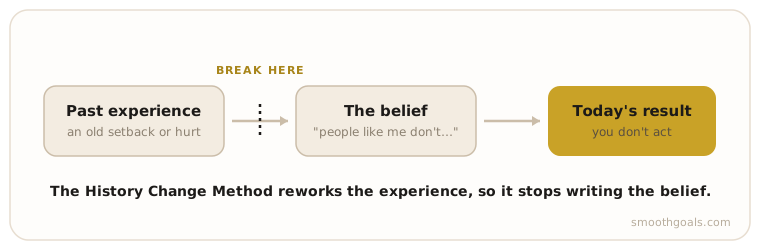
The unsettling part is that the connection often isn't even logical. A humiliation in school can show up decades later as an inability to ask for a raise. A failure in one relationship can resurface as a failure to close a sale. The mind links things that have nothing to do with each other, and then runs the link as law. This is also where your energy goes: instead of spending it on the goal, you spend it fighting an old verdict about yourself — which is why a good plan can sit untouched while you wonder what's wrong with you.
How to Spot Your Own
Limiting beliefs hide, but they leave fingerprints. Here's how to catch them.
Run the certainty test. Picture yourself achieving the goal, starting tomorrow. Are you a hundred percent sure you'll get there? If you hesitated, that hesitation is the belief showing itself — part of you doesn't actually believe it's possible.
Then look at your behavior. The goal you keep almost starting. The task you reorganize your whole day to avoid. The opportunity you talk yourself out of with a reason that sounds sensible. Self-sabotage isn't random; it's a belief protecting itself. And listen for the sentence that starts with "people like me don't get promoted" or "I could never…" — said flatly, as if reporting the weather. That flat certainty is the tell. The deeper version of this is what makes it so hard to stick to a goal even when you know exactly what to do.
Why Positive Thinking Won't Fix It
Here's where I part ways with most advice. The standard prescription is affirmations — stand at the mirror and repeat "I am confident and successful" until you believe it. It doesn't work, and at some level you already know it doesn't, which is why it feels hollow when you try.
Affirmations paint over the belief; they don't remove it. Underneath the fresh coat, the old conviction is still load-bearing — and a part of you is quietly calling the affirmation a lie, which just deepens the conflict. Belief is not enough, and neither is forced positive thinking. You don't talk yourself out of a limiting belief. You have to go back to where it was written and change it at the source. (That's also why I'm skeptical of pure willpower in discipline vs. motivation, and why a routine alone isn't the whole answer in goals vs. systems.)
How to Actually Clear Them
Smooth Goals has two tools for this, both drawn from the useful parts of NLP and stripped of the ritual.
The History Change Method goes back to the experience that wrote the belief and reworks how you hold it — so it stops bleeding its old verdict into the present. The Fingers Method is a short exercise you can run any time the resistance rises, to release the charge in the moment. The point of both is the same: you're not pretending the past didn't happen, and you're not papering over it with slogans. You're changing the meaning it has now, so it stops steering you.
The History Change Method
The Fingers Method
The full step-by-step drills, and how to apply them to a real goal, are in Goal Mastery and the course. Clearing the inner blocks this way is one phase of the complete goal achievement system — the phase most people skip, and the one that quietly decides whether all the others work.
Start Here Today
You don't need to excavate your whole past. Start with one goal. Write it down, picture achieving it, and run the certainty test — am I sure? If a part of you flinches, you've just found the thing that's actually been stopping you. That awareness alone is more than most people ever reach, and it's the first real step toward moving the belief instead of obeying it.
Start the Momentum Method — free
Start the Free CourseThe Momentum Method helps you surface what's quietly fighting your goals — and start clearing it. One short email at a time. Free.
FAQ
What are limiting beliefs?
They're convictions about yourself or the world — usually old and unexamined — that make a goal feel impossible or "not for you." They're powerful because they don't feel like beliefs; they feel like plain facts, so you never question them, and they steer your decisions from out of sight.
How do I know if I have a limiting belief?
Picture achieving your goal and ask whether you're truly sure you'll get there — hesitation is the tell. Watch for self-sabotage: the goal you keep almost-starting, the task you always avoid, the "people like me don't…" sentence said as if it were obvious fact.
Can you really change a belief?
Yes — but not by repeating affirmations over the top of it. A belief is the rule a past experience wrote, so it changes when you go back and rework the meaning of that experience, not when you argue with the belief head-on. That's what methods like History Change are built to do.