Most people track one thing, feel good about it for a while, and quit anyway.
Here's the pattern. You set a goal, you start checking your progress against the result — the weight, the revenue, the word count total — constantly. For the first stretch it's motivating. Then the result stalls, the way results always do in the middle, and the constant checking that used to lift you starts doing the opposite. Every look confirms you're not there yet. So you stop looking, and not long after, you stop trying. The tracking didn't just fail to help. It helped you quit.
The mistake wasn't tracking the outcome. It was checking it on the wrong rhythm — either too often to mean anything, or never at all as the signal it actually is.
Why Checking the Outcome on the Wrong Rhythm Backfires
The outcome — the number you actually want — punishes you when you check it on the wrong clock, for two reasons.
It's often laggy. Many results move slowly and unevenly, well behind the work that produces them. Check a slow-moving number too often and you'll punish yourself for good work that simply hasn't shown up yet.
And it's out of your direct control. You can't do the outcome. You can only do the inputs that eventually produce it. Check it before it's had time to move and, on the days it stalls, it gives you nothing to change except your mood.
That doesn't mean ignore it. It means matching how often you check to how fast the number can actually move — and that's where most tracking advice goes wrong, because it treats "daily" or "monthly" as a universal rule instead of asking where you actually sit.
Match the Rhythm to Where You Sit
Here's the part almost nobody says out loud: how often you should check isn't fixed. It scales with your position, and with how much of the outcome you can move within a given stretch of time.
Say you're a bricklayer with a quota of a thousand bricks today. Checking your count once a week is useless — the day is over long before you'd notice you were behind. You check at midday instead: under five hundred, and you already know to move faster before quitting time. That's the rule for anyone close to the daily execution of the work — track in hours or within the day, because that's the only window where you can still do something about it.
The higher you sit — further from laying the bricks yourself — the longer that window gets, and the more your numbers tie to slower-moving totals: a site manager watches the week across several crews, a director watches the month. None of them are wrong. They're each matching the check to the size of what they can actually move in that period.
The rule isn't "track daily" or "check monthly." It's this: check often enough that you can still act before the period closes, and no more often than that — checking before a number has had time to move just adds noise, not information.
Track the Process, on the Rhythm That Fits Your Role
Your tracker should measure the process — the repeatable input you control — on whatever rhythm actually lets you act. Not "am I there yet," but "am I on pace for this period." This connects directly to the difference between process goals and outcome goals — you set the outcome to aim at, but you track the process to move, at whatever cadence your role calls for.
Here's the kind of shift that means in practice:
| Track this — the input you control | Check this on a slower clock — the lagging outcome |
|---|---|
| Am I on pace for today's target? | The number on the scale |
| Words written this session | Whether the book "feels" finished |
| Sales calls made so far today | This month's revenue |
| Did I follow the plan so far? | Where the result "should" be by now |
A process tracker is honest in a way a mistimed outcome check isn't. Mid-period, it still shows you winning — because you did win the part that was yours to win — and that's the evidence that carries you through the flat middle, the same way a protected streak keeps you consistent when motivation is gone.
Check the Outcome Too — On Its Own Rhythm, Not Never
Here's the part that gets lost when "track the process" turns into "ignore the outcome": you still need to check the outcome, on whatever rhythm actually shows movement, because it's the only thing that tells you whether the process is working at all.
More sales calls made means nothing if sales aren't increasing. That's not evidence to make even more calls — it's a sign that calls aren't the problem, conversion is. The process tells you what you did. Only the outcome tells you if it worked.
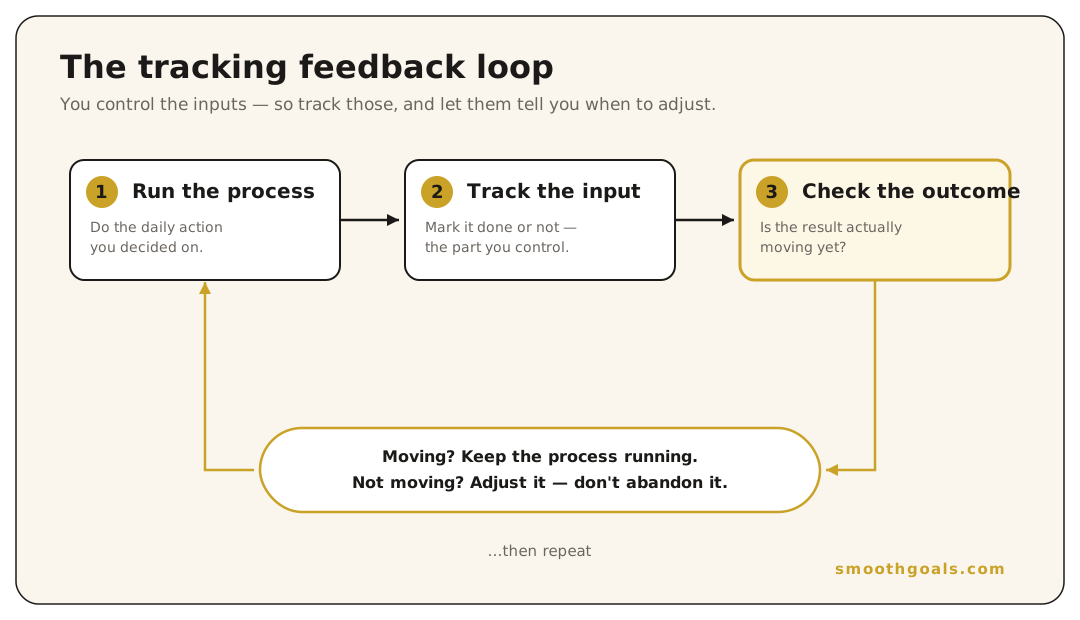
That's what the slope is for. Once you check the outcome, at the rhythm that fits your role, and see it trending up, flat, or down, Smooth Goals has a specific Success Formula for each state — laid out in full in Goal Mastery and the course. You're not guessing what to change; the direction of the outcome tells you which formula to run, then you go back to running the process and checking again. That cycle looks like this:
The Hard Part — and Where the System Takes Over
Here's where it gets genuinely difficult, and where most self-built trackers fall apart.
Deciding to track the process is easy. Knowing which process to track, and on what rhythm to check it against the outcome, is not. For any given goal there are a dozen things you could measure, and only a few of them actually forecast the outcome — the rest are busywork that feels like progress and predicts nothing. Pick the wrong inputs and you'll diligently track your way to a result you never wanted, checkmarks all the way. And even with the right inputs, reading the signal well — how much movement is enough, how tight the check needs to be for your position, which Success Formula fits the state you're actually in — is a judgment needing careful thought.
Working out the handful of inputs that actually predict a specific outcome, and knowing which Success Formula to run once you see where the line is heading, is the part the goal achievement system is built to do — it's the difference between a tracker that steers you and one that just keeps score.
If you want to start on the right foot today, the free Momentum Method course gets you tracking the one small input that keeps a goal moving — the honest, in-your-control kind. Seven short emails, no cost.
Start the Momentum Method — free
Start the Free CourseThe Momentum Method gets you tracking the one small daily input that keeps a goal moving — one short email at a time. Free.
Frequently Asked Questions
How do you track progress on a goal?
Track the process on a rhythm that matches your role — the closer you are to the actual work, the tighter that rhythm should be. Check the outcome too, on its own rhythm, and use it as a feedback signal: if honest effort isn't moving the result, that tells you which Success Formula to run — adjust the process rather than abandoning the goal.
Should you track the process or the outcome?
Both, but not on the same clock. You track the process on whatever rhythm your role calls for — a direct executor might check hourly, someone further up checks weekly or monthly. You check the outcome too, on its own slower rhythm, never ignored, because it's the only thing that tells you whether the process is actually working.
Why doesn't tracking my goals seem to work?
Usually one of two mistakes: checking a slow-moving outcome too often, which mostly demoralizes you without giving you anything to act on, or tracking the process and never checking the outcome at all, which means you can do the wrong thing for months without knowing it. Match your checking rhythm to your position, and use the gap between process and outcome to tell you what's actually working.