You've got a dozen goals, and every one of them matters. Get fit, grow the income, learn the language, fix the side project, read more, sleep better. It feels like drive — like you're a person who wants a lot from life. So why does the list never seem to shrink?
Because that long list is the reason nothing on it gets finished. The problem isn't your ambition; ambition is good. The problem is the math. Spread across a dozen goals, your time and energy get sliced so thin that no single goal gets enough to actually cross the line. The fix isn't to want less. It's to aim all of it at one thing at a time.
Not Every Goal Is Competing for the Same Slot
Before you pick the one, sort your list into two piles, because they're not the same kind of goal. Some things — sleep, basic health, the relationships you can't afford to neglect — aren't ambitions competing for your spare time. They're the floor. Damage the floor and every other goal gets harder, including the one you supposedly chose to focus on. You can't build a business on four hours of sleep and call the sleep goal "parked" — you just moved the cost onto the business goal instead.
The "one at a time" rule is for the other pile: the ambition goals actually competing for your discretionary hours — grow the income, learn the language, finally start the side project. Protect the floor without exception, then run one ambition goal on top of it. That's not a compromise on focus. It's what makes the one goal you did choose actually survivable.
Why Too Many Goals Means Zero Finished
There's a simple way to see what's happening. The energy you have for goals on any given day is fixed — and when you divide it among many goals, each gets a fraction too small to produce a visible result. No result means no encouragement, no encouragement means you drift, and one by one the goals go quiet. You didn't fail at twelve goals through weakness. You starved all twelve at once.
It gets worse, because the goals don't just share energy — they fight. The goal to earn more wants you at the desk; the goal to be a present parent wants you at home; the goal to get fit wants the early morning the late night took. When goals pull against each other like this, you burn your energy refereeing the conflict instead of moving any of them forward. That hidden drain is a big part of why goals are so hard to stick to — you're not lazy, you're overcommitted.
Use the Wheel of Life to Choose
So how do you pick the one? Don't choose by which goal shouts loudest today. Step back and look at your whole life first.
The tool I use for this is the Wheel of Life: list the areas that actually matter — health, finance, career, personal growth, family, relationships, social life, fun — and honestly rate where each one sits right now, 0 to 10. Two things jump out immediately. You see which area is most out of balance and genuinely needs attention. And you see where you're about to over-invest, pouring everything into the area that's already strong while another quietly collapses. The right goal to choose is usually the one that restores balance, not the one that's simply most exciting. (You can run your own Wheel of Life free on the site.)
One Goal at a Time Is Leverage, Not a Limit
People resist this because focusing on one goal feels like giving up on the others. It isn't. It's sequencing them so they actually happen.
Finishing one goal doesn't just get you that goal — it makes you stronger for the next. You build skills, proof, and the quiet confidence that comes from completing things, and you carry all of it into goal number two. Run your goals one after another and each starts from a higher base than the last. Run them all at once and each starts from the same starved, scattered place forever. One at a time isn't the small-minded option; it's the leverage. It's also why the whole goal achievement system is built around a single goal at a time, not a sprawling list — and why setting a reachable target matters as much as choosing it (more on that here).
Knowing When to Bend and When to Drop
Focus raises a hard question: what about the goals you set aside — and the ones that stop working? This is where flexibility comes in, and it cuts two ways.
First, bend the path, not the goal. When you hit an obstacle — the bank says no, the plan falls through, life gets in the way — that's not a signal to quit. It's feedback telling you to change the route, not the destination. The rigid person treats the first obstacle as the end. The flexible person keeps the goal fixed and finds another way around. The only way to truly fail is to stop.
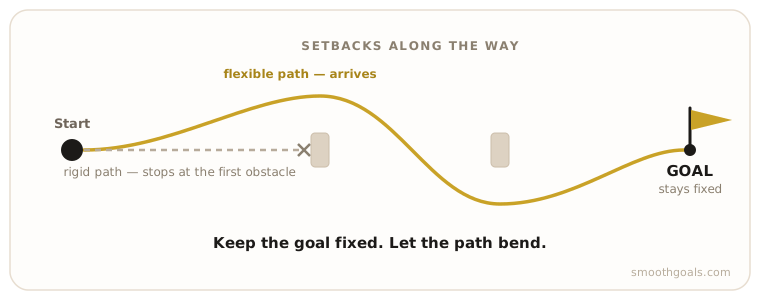
Second — and this is the harder honesty — sometimes the disciplined move really is to drop a goal. Not because it got hard, but because it no longer serves you, or you only kept it out of stubbornness and sunk cost. The skill is telling the two apart: "I want to quit because this is uncomfortable" is usually a reason to bend the path and continue. "This goal isn't actually mine anymore" is a reason to let it go cleanly and free that energy for the one that is. Flexibility isn't weakness. Knowing the difference is one of the most useful judgments you can develop. (When a good goal keeps stalling for reasons you can't name, that's often not a reason to drop it but a hidden belief worth examining.)
How to Prioritize When Everything Feels Important
If you're staring at a list and they all feel equally urgent, use one question: which goal, if I achieved it, would make the others easier or even unnecessary? There's almost always one. The goal that unlocks money buys time for the others. The goal that builds a skill makes three later goals trivial. Find that keystone goal and start there.
Then do this for the rest, and it's the part people skip: don't abandon them — park them, in writing. A goal on a "later" list isn't a goal you failed; it's a goal you've deliberately scheduled for after the current one. Parking the rest is what makes single-minded focus feel safe instead of like loss. You're not giving anything up. You're putting it in line.
Start Here Today
Write down every goal you're currently carrying — all of them, the whole guilty list. Now pick the single one that matters most right now, or the keystone one that makes the others easier. Park everything else on a clearly labeled "later" list. Then work only the one you chose. That's the entire exercise, and it will do more for your results than any amount of trying to do it all.
Start the Momentum Method — free
Start the Free CourseThe Momentum Method helps you cut the list to the one goal that matters and actually move it. One short email at a time. Free.
FAQ
How many goals should I work on at once?
One. Your time and energy are finite, and splitting them across several goals means none gets enough to finish. Choose one, complete it, and let the strength and confidence from finishing carry into the next. Sequential beats simultaneous almost every time.
How do I choose which goal to focus on?
Step back and look at your whole life — a tool like the Wheel of Life helps — and pick the goal that most restores balance or, better, the keystone goal that would make your other goals easier or unnecessary once achieved. Don't choose by which one feels loudest today.
Can I work on a health goal and a business goal at the same time?
Yes, if they're not the same kind of goal. Basic health, sleep, and the relationships you can't afford to neglect aren't ambitions competing for your time — they're the floor everything else stands on. Protect those without exception, then run one ambition goal on top, like growing the business. What you shouldn't do is run two ambition goals at once, both competing for the same limited hours and attention.
Is it okay to quit a goal?
Sometimes, yes. If you want to quit because it got hard, that's usually a cue to change your approach and keep going — bend the path, not the goal. But if a goal genuinely no longer serves you or was never really yours, dropping it cleanly frees your energy for one that does. The skill is telling those two apart.